
Most supplier comparisons collapse into a price-per-pack spreadsheet. That works for a commodity repeat order and fails badly for a private label range — because the parts of the cost that decide whether the product actually sells are usually the parts the quotation never itemises.
Below is the sequence we would use ourselves if we were buying rather than making. It is deliberately unglamorous: none of it is about showroom visits or factory videos.

Start with the spec, not the quotation
Before a supplier can quote honestly, six variables have to be fixed: wipe dimensions, fold type, substrate weight (GSM), fibre blend, liquid load, and pack format with piece count.
Of those, GSM and blend move the cost more than anything else on the list. In consumer wet wipes, 40–50 gsm is the most common band; household and industrial formats run heavier. Viscose content raises cost but improves softness and liquid retention, so a 45 gsm sheet at 30% viscose and a 45 gsm sheet at 50% viscose are not the same product and should not be the same price.
A supplier who quotes a number before asking about GSM, sheet size and piece count is not quoting your product. They are quoting a guess, and the gap will surface after you have paid for printing plates.
Ask what their machines cannot do
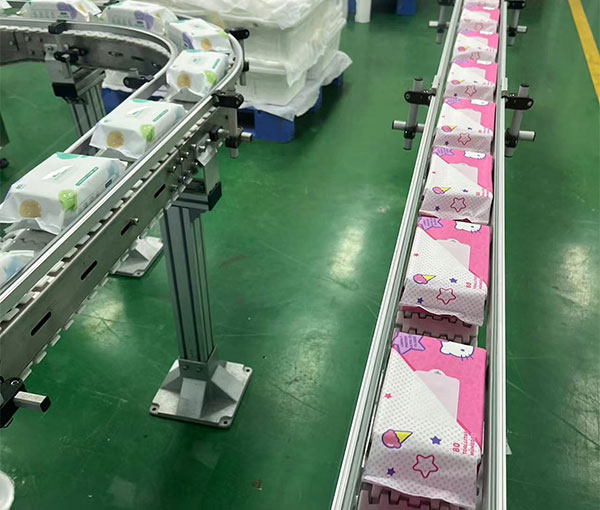
Every factory has fixed mechanical limits, and a good supplier will volunteer them. Common ones: a maximum pack side height that caps piece count at a given GSM, a minimum bearing length that rules out short wide formats on certain folders, and specific fold geometries each machine can run.
This is the single most useful conversation in supplier selection, because it cannot be faked. “We can do anything” means either nobody checked, or the order will be subcontracted.
| Limit | Why it exists | What to ask |
|---|---|---|
| Pack side height | A high piece count at high GSM exceeds the film tube the machine can form | “What is the maximum piece count for 45 gsm in this pack format?” |
| Bearing length | Some folders are fixed on one axis, so one wipe dimension cannot go below a set size | “Which sheet sizes can your folders actually run?” |
| Fold type | Z-fold, W-fold and multi-fold each need different folding plates | “Which fold does this line run, and does it change the extraction?” |
| Bag minimum | The film printer’s minimum, not the factory’s, is often the binding constraint | “What is the bag MOQ for this format?” — see section 04 |
Separate registration from certification
These get bundled together in supplier decks and they mean very different things.
Registration is a filing. For cosmetic wipes sold in the US, that means facility registration and product listing under MoCRA, plus a US agent for a foreign facility. There is no “FDA certificate” issued for a baby wipe — if a supplier offers you one, treat the wording as information about how carefully the rest of the compliance file is being handled.
Certification is a third-party audit against a standard — ISO 9001, GMP, FSC chain of custody, SEDEX. Three things to verify on any certificate you are shown: the legal entity named on it, the scope (does it cover wet wipes, or only dry nonwoven?), and the expiry date.
A logo wall proves nothing. Ask for the certificate number and the issuing body, then verify it independently. This takes ten minutes and eliminates most of the risk in this section.
Treat packaging as half the project
Buyers habitually negotiate the wipe and accept whatever the bag costs. That is backwards, because the film usually sets the real minimum order.
Bag printing commonly carries a minimum of 20,000–50,000 bags per print run, with smaller pack formats tending toward the higher end. Add a plate or cylinder fee charged per colour, and the packaging line can exceed the wipe cost in a small first order.
If you are launching two or three brands on the same pack format, print the base film unbranded and put the brand on the lid sticker. The bag minimum is then shared across the range instead of being duplicated for each brand — the single biggest lever on first-order cost in this category.
Run a sample protocol, not a sample request
- Send a written spec, not a reference photo. Dimensions, GSM, blend, liquid load, piece count, pack format. A photo gives you a resemblance; a spec gives you a product.
- Ask for two packs, not one. One to test to destruction, one to keep as the reference for the next order.
- Measure, do not feel. Sheet dimensions after extraction, pack weight, GSM by cut sample, and pH of the lotion. These are the four numbers that reveal substitution.
- Test the extraction, not just the sheet. A single wipe should come out cleanly without tearing or dragging the next one with it. This is where cheap folds show up.
- Ask what the shelf life claim is based on. A stability statement or preservative efficacy data — not “two years, no problem”.
- Re-order the same spec three months later and compare. Consistency across repeat orders is what separates a factory from a trading company, and it is invisible in any single sample.

Read the red flags
A figure arrives before anyone asks about GSM, size or piece count. The number is not about your product.
A supplier who cannot state the bag MOQ or name the film printer does not control the packaging — or the lead time.
Not issued for cosmetic wipes. Offering one suggests the compliance file is assembled from templates.
If the sample arrives without written parameters, there is nothing to hold the production run against.
Score the answers, not the price
Rank suppliers on the six dimensions below before you rank them on cost. In practice, the cheapest quotation is usually the one with the thinnest answers underneath it.
| Dimension | What good looks like |
|---|---|
| Spec depth | Pushes back on vague requirements and asks for the missing variables |
| Machine honesty | Names limits before you discover them, and explains the workaround |
| Documentation | Certificate numbers, scopes and expiry dates offered without prompting |
| Packaging control | Knows the bag minimum, the plate cost and the lead time on film |
| Sampling discipline | Ships samples with a written spec sheet attached |
| Technical responsiveness | Replies with measurements and reasoning rather than reassurance |
What to put in your first message
One page, six lines: sheet size and fold · GSM and fibre blend · liquid load or lotion type · pack format and piece count · target market and required documentation · annual volume with first-order quantity. Suppliers who receive this either answer precisely or expose themselves quickly. Both outcomes save you weeks.
Send us the one-page spec
If you are building a private label range and want a straight answer on what your format can and cannot do, send the six lines above. We will respond with the machine constraints, the bag minimum and a realistic timeline — before any plates are ordered.
OEM and ODM wet wipes for baby, personal care and household ranges, supplied to brand owners and distributors across Europe, North America, South America and Southeast Asia.
Product specifications, minimum order quantities and lead times vary by format and material. Confirm the figures that apply to your programme at quotation stage.